Key Takeaways:
- Is employer disability insurance enough for physicians?
Employer group disability insurance can provide valuable baseline protection, but benefit caps, taxes, offsets, disability definitions, and other contract provisions may limit the amount or availability of benefits. - What is private disability insurance for physicians?
Physician-focused private disability insurance can provide personally owned, portable coverage with contractual provisions designed around protecting a physician’s medical specialty. - What is True Own Occupation disability insurance?
A True Own Occupation definition can allow a physician to qualify as totally disabled when unable to perform the material duties of their specialty while potentially working in another occupation. - What should physicians ask HR about employer disability insurance?
Ask about income replacement percentages, monthly benefit caps, taxation, disability definitions, waiting periods, exclusions, offsets, and Social Security disability requirements.
What is the difference between employer disability insurance and private disability insurance for physicians? Many residents, fellows, and attending physicians receive group long-term disability insurance through their employer and assume their income is adequately protected.
In this episode of The Responsible Resident, Amber Stitt explains how employer disability insurance works, where group coverage may have limitations, and why physicians should understand how it compares with personally owned, private disability insurance.
How Does Employer Disability Insurance Work for Physicians?
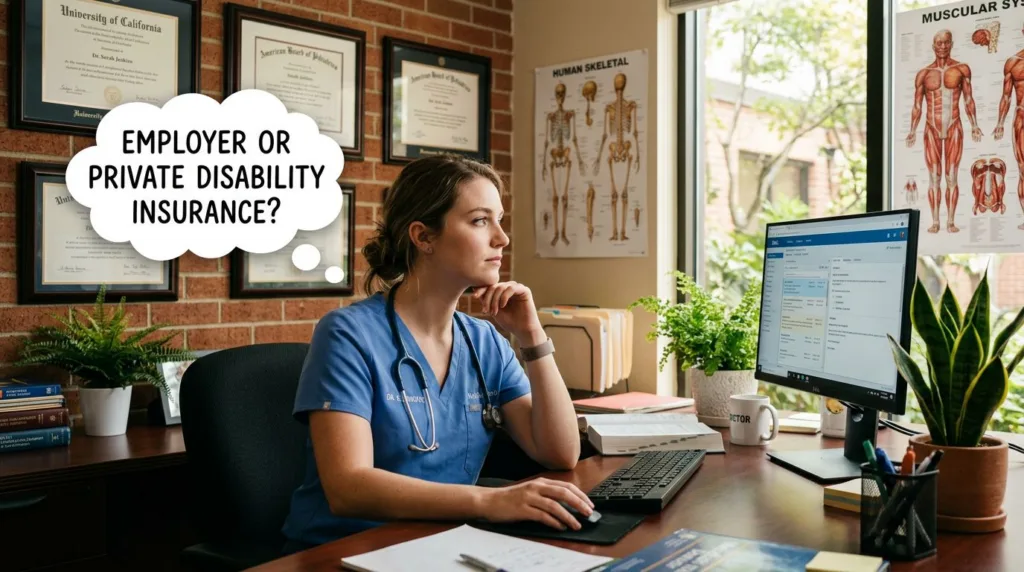
Employer-sponsored group disability insurance is commonly offered to residents, fellows, and attending physicians as part of an employee benefits package. It generally provides a baseline layer of income protection and may cover employees regardless of individual health history.
However, physicians should review the actual group disability insurance certificate, not simply the benefits summary. Group plans may replace only a percentage of base salary, impose a maximum monthly benefit, offset benefits based on other income, and tie coverage to employment.
What Should Physicians Ask About Their Employer Disability Plan?
Understanding the details of your employer disability insurance is critical when evaluating income protection.
Physicians should ask HR:
- What percentage of my base salary does the plan replace?
- Is there a maximum monthly disability benefit?
- Would my disability benefits be taxable?
- Can I obtain a copy of the complete group certificate?
- How does the policy define disability?
- What is the waiting period?
- Are there exclusions or limitations?
- Does the policy require me to apply for Social Security Disability Insurance?
These questions can reveal important differences between the coverage physicians believe they have and how the contract may actually operate during a claim.
Why Do Social Security Disability Requirements Matter?
Some employer-sponsored disability plans may require an insured physician to apply for Social Security disability benefits. Group policies may also contain provisions that offset benefits based on other sources of income.
The episode illustrates this through the story of a dentist who could no longer practice dentistry but transitioned into another profession. His individual disability policy approved his claim based on his inability to perform his occupational duties, while his group coverage ultimately did not pay because he was able to work in another capacity.
How Is Private Disability Insurance Different for Physicians?
Private disability insurance is designed to follow the physician rather than the employer. Physician-focused policies may provide a True Own Occupation or own-specialty definition, allowing a physician to potentially receive benefits when unable to perform the material duties of their medical specialty even if they work elsewhere.
Private coverage is also portable. If a physician changes hospitals, enters private practice, relocates, or transitions into another medical role, the personally owned policy can remain in place.
Why Are Portability and Rate Locks Important?
Many private physician disability policies are structured as non-cancelable and guaranteed renewable. As described in the episode, this generally means the insurer cannot increase the individual physician’s premium because their personal risk profile changes, and future health changes cannot be used to add new exclusions to an already-issued policy.
For physicians with long and evolving careers, these contractual protections can provide greater continuity and control.
Why Should Physicians Compare Employer and Private Disability Insurance?
A physician’s ability to practice medicine can represent one of their largest financial assets.
Understanding both employer disability insurance and private disability insurance helps physicians evaluate how effectively that asset, and the income supporting their financial life is protected.
From Amber’s Desk
Employer disability insurance can provide an important starting point, but physicians should understand its benefit limits, tax treatment, offsets, disability definitions, portability, and Social Security requirements.
Private physician disability insurance may offer additional control through personally owned coverage, portability, rate guarantees, and specialty-specific disability definitions.
The goal is not simply to ask, “Do I have disability insurance?” It is to understand how your disability insurance would actually work if you needed to use it.
You don’t need to make a decision today, but you do need to understand your options.
Clarity creates confidence.
To take the next step and build a strategy that supports your career and financial future, download the FREE Medical Professionals Blueprint here.
About Amber Stitt
Amber Stitt is a nationally recognized Disability Insurance specialist with over 15 years of experience helping physicians and high-income professionals protect their income and financial stability.
As co-owner of MD Disability Quotes with top Disability Expert, Scott Nelson-Archer, and founder of Stitt Strategies, Amber works with physicians nationwide to design income protection strategies that are personal, portable, and aligned with the realities of a specialized medical career.
She is also the host of The Responsible Resident, an education-first podcast focused on helping medical trainees understand how financial decisions, especially around income protection and underwriting, can shape their long-term options.
Her work centers on helping physicians make informed decisions before limitations appear, so they can protect their income, preserve flexibility, and move forward with confidence.
If you would like to schedule a disability insurance strategy session, click here.
If you would like to request physician disability insurance quotes, click here.
You can email us: info@amberstitt.com
Call 480-707-2771 (9 AM-5 PM MST)
Text “Insurance” to 480-707-2771 at your convenience.